


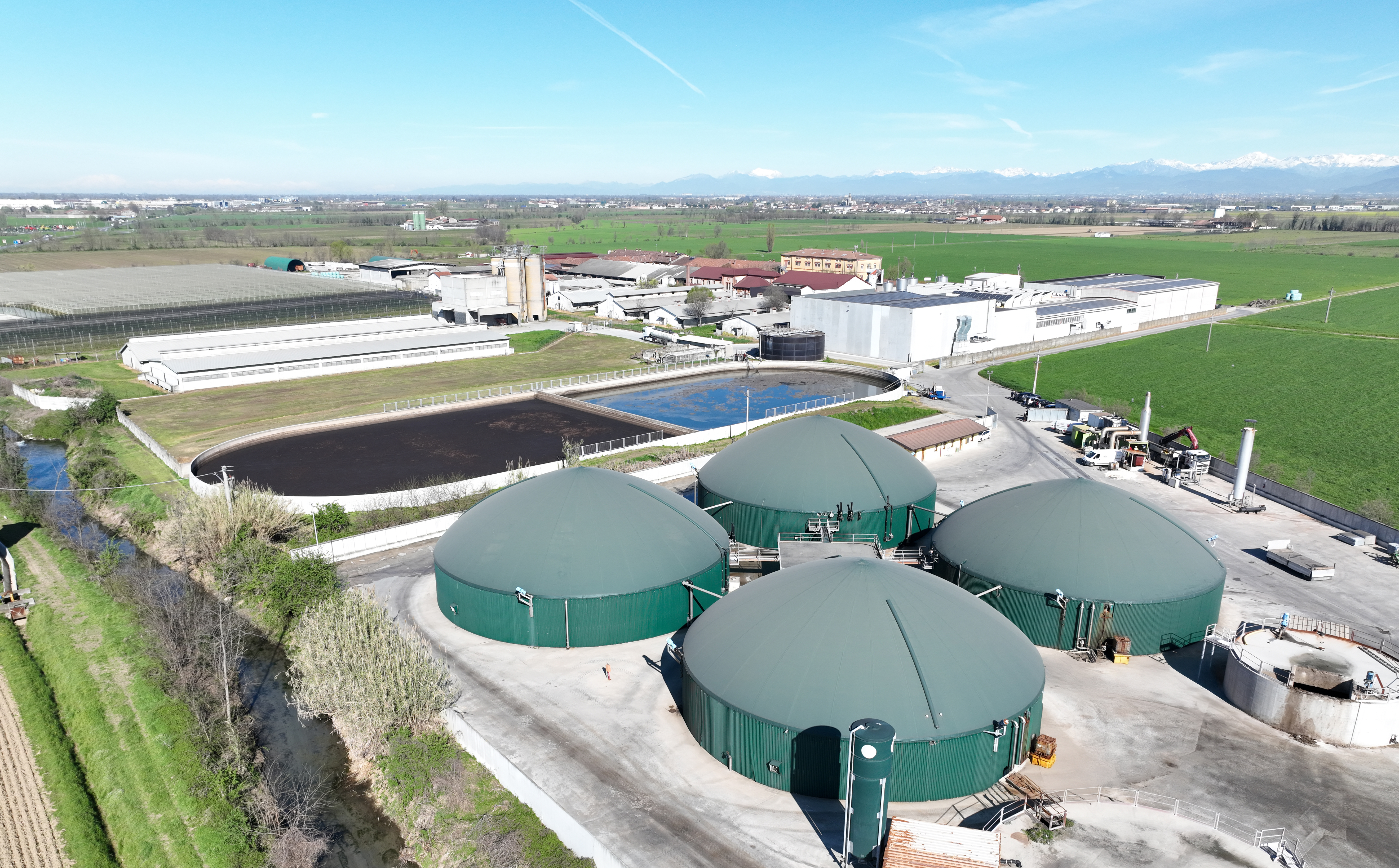
Biogas in Italy and Europe 2025-2035: how it is evolving
Let’s be honest: since its introduction in Italy, the biogas sector has been highly divisive among farmers. On one hand, some have seen it as largely ineffective in meeting the real needs of agricultural businesses, viewing it as a complex, costly sector far removed from the daily management of a traditional farm. On the other hand, others have seen it as a potentially revolutionary opportunity, capable of turning waste and by-products into value, reducing environmental impact, and generating an alternative, more stable economic flow. This dual perspective largely stems from tangible factors. Smaller farms or those with limited investment capacity have often struggled to see biogas production as useful to their production model, while more structured and innovative operations quickly grasped the benefits of integrating agricultural production with renewable energy. Supportive policies, technological progress, and access to knowledge have reinforced this initial divide between scepticism and trust. Over time, however, the picture has evolved. Field experience, improvements in plant management, and growing institutional interest in the circular economy have reduced early criticism, strengthening the perception of biogas as an integral part of a new agricultural and energy vision. By 2025, the sector has essentially reached a maturity stage, positioning it among the key segments active in the national ecological transition. European directives, the push toward climate neutrality, and the need for more resilient agricultural systems have given new momentum to biogas, transforming it from a niche experiment into a strategic component of the energy mix and agricultural model in Italy and Europe.
The relationship between biogas and agriculture has been ambivalent from the start. For some farmers, installing an anaerobic digestion plant meant acquiring new skills, managing more complex processes, and dealing with regulatory and bureaucratic challenges. Not everyone was willing or able to do so. For others, however, a biogas plant represented a breakthrough, providing more stable income, reducing dependency on external factors, and improving business competitiveness. This diversity of perceptions reflects the very complexity of the Italian agricultural sector, fragmented into thousands of farms of varying sizes and characteristics. Adoption of biogas has therefore been uneven: some areas of the country have seen significant plant proliferation, while others have remained more distant. The type of agricultural production has also influenced adoption rates: livestock farms, for example, were more motivated due to the availability of waste to valorise.
As of 2025, biogas in Italy occupies a unique position: it is neither new nor a passing trend but a consolidated technology with strengths and weaknesses. Structural challenges remain, but the sector enjoys increasingly broad recognition. The national energy landscape has changed rapidly. The transition to renewables has accelerated, driven by European directives and the need to reduce reliance on fossil fuels. In this context, biogas has carved out a specific role, different from other renewable sources such as solar or wind. It is not just about producing electricity or heat, but about offering a multifunctional solution that combines agricultural production, waste management, emission reduction, and local supply chain development. The sector has undergone significant internal transformation. While early plants were primarily designed for incentivised electricity production, attention has now shifted to biomethane. This evolution has been supported by specific policies and growing demand for renewable gas for civil, industrial, and especially transport use. Biomethane has become the new frontier, integrating biogas more directly and competitively into the national and European energy markets. Farms that have invested in converting or building plants suitable for biomethane production now enjoy a more solid outlook. They can rely on supply contracts, participate in market mechanisms, and contribute concretely to the country’s decarbonisation goals. However, not all farms have had this opportunity. Significant differences remain between large and small farms, with smaller farms often penalised by the difficulty of sustaining high investments or accessing advanced technologies.
Biogas development in Italy has neither been linear nor without obstacles. Today, we can speak of a consolidated sector thanks to numerous adaptations, adjustments, and corrections involving both technology and business models. One of the most complex aspects concerns investment costs. An anaerobic digestion plant requires significant initial capital for construction and grid connection. Early incentives ensured a relatively quick return, but with progressive subsidy reductions, farms faced narrower margins and longer payback periods. This created a natural selection where only the most solid or innovative operations could survive. From a technical perspective, challenges were equally demanding. A biogas plant requires expertise in biological and chemical processes, as well as careful organisational management. Simply “feeding” the digester is not enough: substrate balance, constant process monitoring, and stable operation are essential. Many early difficulties arose from underestimating this complexity. Farms that invested without adequate training or consultancy quickly faced underperforming or mismanaged plants. Long-term profitability is another concern. Italian agriculture is fragmented, characterised by small- and medium-sized family farms. These farms often lack the capacity for multimillion-euro investments or to bear risks from volatile energy markets. Limited access to credit further favoured larger companies and cooperatives, leaving isolated farms at a disadvantage. Conversion to biomethane has opened new opportunities but also highlighted this division. Not all farms could afford the upgrade, especially for retrofitting plants with upgrading systems needed to “elevate” biogas to biomethane.
Technological innovation has been a key driver of biogas growth. Without ongoing research and improvements, the sector could not have overcome initial limitations or achieved today’s efficiency levels. Anaerobic digestion, in its simplest form, is an ancient biological process, but industrial application required significant optimisation efforts. Research focused on understanding microbiological processes, the role of bacterial communities, and their capacity to degrade different substrates. This knowledge allowed better mixture balancing, reduced retention times, improved plant stability, and increased energy yield. Innovation has also affected plant technology. Digesters have become more reliable and flexible, with real-time monitoring systems and management software that anticipate issues and optimise parameters. Upgrading technologies, needed to transform biogas into biomethane, have advanced from costly, complex systems to more accessible, modular solutions suitable even for small plants. Digestate management is another crucial research area. Initially seen as a by-product, it is now valued as a high-quality fertiliser. Studies have demonstrated its effectiveness in returning nutrients to soil, improving fertility, and reducing dependence on chemical fertilisers. Separation and refining techniques produce targeted products with balanced nitrogen, phosphorus, and potassium content, easily absorbed by crops. Digitalisation is equally important. Precision agriculture, sensors, and advanced analysis systems have transformed plant management. Farmers can now monitor biogas production, process parameters, and digestate quality directly from smartphones, intervening quickly in case of anomalies. This evolution increases efficiency, reduces costs, and makes management accessible even to those without advanced technical backgrounds.
Europe’s biogas and biomethane landscape is a mosaic of experiences, strategies, and adoption rates. Western Europe has consolidated models, economies of scale, and relatively structured certificate markets. Eastern European countries still hold significant untapped potential, but face infrastructure delays and require more coherent support policies. Understanding these differences is essential for policymakers, investors, and those integrating energy production into local agricultural systems. In France, the approach has been cautious and gradual, avoiding past mistakes. Incentives favour by-products and waste over dedicated crops, and plant deployment follows territorial logic to integrate biomethane into local value chains. French technology workshops and agricultural cooperatives focus on medium-sized modular plants, replicable and low-risk. The approach promotes steady growth with attention to digestate quality and social acceptance. France has also piloted biomethane use in mobility and local distribution, linking agricultural production with industrial demand. Germany is Europe’s most mature biogas market. Technology is deeply embedded in agriculture, and plant solutions are multiple and sophisticated. Long-standing experience has allowed experimentation with models from small rural plants to large industrial units. Support policies, technical standards, and an efficient advisory network have professionalised the sector. Recently, Germany has focused heavily on converting plants to biomethane and integrating with origin certificate markets, enabling renewable gas sales to industrial and mobility clients. Germany’s ability to combine innovation, technical training, and access to credit has been crucial to its leadership. Spain has experienced a more uneven trajectory due to agricultural fragmentation and climate variability. Regional gaps are evident, and plant deployment has been patchy. Recently, attention has grown, supported by regulatory reforms and incentives promoting biomethane for sustainable mobility, especially in heavy transport and regional public transport. Innovative projects aim to create territorial hubs where farms share plants and logistics, overcoming size constraints and achieving economies of scale. In the Netherlands, the sector is highly automated with strong focus on digestate quality as a commercial product. Plants are often medium-small but technologically advanced, with sophisticated monitoring and management systems maximising output and by-product quality. Dutch focus on environmental regulation and quality standards supports an integrated, efficient biogas supply chain, with careful water management and mitigation of local impacts. In Eastern Europe, the situation is diverse but unified by high potential. Romania, Hungary, Poland, and other central and eastern states have agricultural areas and livestock waste suitable for economically viable biogas plants. However, adoption has been slowed by infrastructure gaps, limited financial services, and lower technical standardisation. Energy independence pressures and sustainable agriculture objectives are encouraging targeted policy adoption, but coordination platforms are often lacking. In Romania, interest in biomethane is growing for energy and agricultural valorisation reasons, with medium-sized, associative projects where multiple farms share plants. In Hungary, legislation has opened to support mechanisms, but administrative capacity and technical training need further investment. Poland faces similar dynamics: great potential, but the need for logistics and technical advisory networks to reduce project risks. A common theme across Europe is standardisation and interoperability. Mature markets have reliable biomethane tracking systems and certificate markets, enabling producers to monetise environmental value. Lagging countries can accelerate plant installation and market access by adopting international standards and participating in technical cooperation networks. Territorial clusters are another important factor. Where resources, skills, and investments are aggregated locally, plant deployment is faster and more sustainable. Clusters overcome size constraints, distributing costs and benefits while creating territorial biomethane supply chains involving service providers, local industries, and distribution networks. Cross-country cooperation can also play a key role. Sharing best practices, adopting common technical standards, and creating pan-European certificate markets can boost sector growth. For less experienced countries, integrating projects into transnational value chains can attract investment and secure reliable markets.
Strategic planning is essential for farms entering the biogas sector. Choosing the right technology, defining organic feedstock sources, designing modular and scalable plants, and establishing a sustainable economic model are crucial steps. Adopting digital monitoring and management tools via advanced software maximises output, reduces operational risks, and ensures regulatory compliance. Investors must evaluate variables affecting profitability: plant size, location, access to biomethane markets, maintenance and digestate management costs, and availability of public incentives. Collaboration with cooperatives or territorial consortia can significantly reduce risk and improve overall efficiency. Diversifying revenue sources, selling electricity, heat, biomethane, and digestate, is a prudent strategy to ensure economic stability even in volatile energy markets. Integration with European and national regulations is crucial. Operators must understand rules on biomethane origin certificates, environmental norms for waste disposal, and plant safety requirements. Technical training, consultancy support, and adoption of shared operational standards reduce errors and speed up project implementation. Finally, territorial networks, participation in supply chain consortia, and exchange of best practices among operators and investors are decisive levers for sector consolidation. These networks promote process standardisation, technical knowledge dissemination, cost reduction, and access to wider markets, creating a resilient and sustainable ecosystem around biogas and biomethane production.